

Microsoft Debugs Quantum Software in Virtual Reality, Catches Up To Minority Report
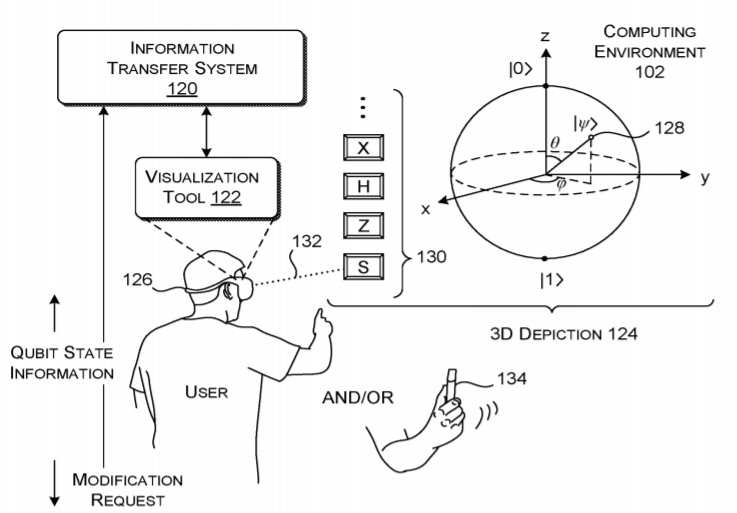
In almost every Sci-Fi film, there is a scene where some scientist is manipulating holographic images with just their hands. Microsoft is interested in making that technology a reality. Patent Forecast® has captured Microsoft in Quantum Computing – but it’s not their normal type of patent. A patent issued in March 2021 to Microsoft for a way to debug quantum programs using virtual reality. A question comes to mind: why do you need virtual reality to do this when programmers debug software all the time without it? The question brings into focus coming challenges to implementing quantum technology.
Let us explain. With a classical computer, debugging is often done with a debugging tool, which runs the program and looks for breakpoints in the code, where there might be a misplaced symbol or an early termination to the program. Classical computers can operate like this because, when coding, the physical bits being manipulated don’t need to be considered by the programmer: the logic of the software program is the only major concern. However, with quantum computing, the physical hardware begins to be a limiting factor. The logic of the code for a quantum computer might make sense, but it could inadvertently change the state of one or more of the qubits without the programmer even noticing. Microsoft’s invention is meant to address this issue, by allowing quantum programmers to directly visualize individual qubits and detect if there is an erroneous change in their states.
Microsoft’s patent is unusual for the Quantum Computing Patent Forecast®, but in line with Microsoft’s tendency to approach the field much differently than its competitors. For example, while Microsoft’s competitors tend to use superconducting qubits (e.g. D-Wave Systems, IBM), ion trap qubits (e.g. IonQ), or Photonic qubits (e.g. PsiQuantum), Microsoft has unusually chosen to focus on topological qubits. Topological qubits are based on two-dimensional quasiparticles called anyons. Unlike three-dimensional particles, like fermions and bosons, the position of two identical anyons can be swapped while still resulting in a change in each anyon’s wave function. Much less is known about anyons than traditional three-dimensional particles, but they appear to offer a way to generate a more robust quantum computer.
While companies like D-Wave Systems and IBM are on track to build a working quantum computer quickly, if a sudden paradigm shift occurs in quantum computing, there’s a good chance Microsoft is behind it. To catch new developments in quantum computing before they are taken to market, make sure to check out the Quantum Computing Patent Forecast®!
Related Posts

IBM and Google are building it, but who will come?
Unlike many other sectors, the Quantum Computing sector has so far been dominated by a few major hardware developers: IBM, Google, D-Wave…


The Quantum British Invasion
In the race to develop Quantum Computing, in addition to facing challenges across the Pacific in the form of China’s Jiuzhang Computer, the…

IonQ Suggests Error Correction is the True Test of Quantum Computers, but is it Prepared?
Forget everything you know about quantum volume. Ok, maybe we should explain what quantum volume is before telling you to forget. Classical…